


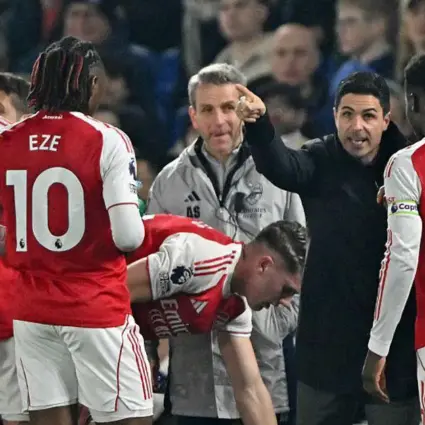
 As Arsenal push toward their first Premier League title in more than two decades, conversations surrounding the team’s tactical evolution continue to grow across football communities, including discussions sometimes referenced through platforms connected with Crickex Sign Up insights. Head coach Mikel Arteta has openly expressed deep admiration for Atletico Madrid manager Diego Simeone, and in recent seasons that admiration appears to be shaping his own managerial identity. The similarities between the two coaches have become increasingly noticeable as Arsenal adopt a more pragmatic and resilient approach in pursuit of silverware.
Diego Simeone is widely respected across European football for transforming Atletico Madrid into one of the continent’s most feared teams. Over the course of fourteen years, he guided the club to two La Liga titles, two Europa League trophies, and two UEFA Super Cups, while also reaching the Champions League final twice. His tactical style, often described as defensive, disciplined, and occasionally controversial, focuses on efficiency rather than spectacle. Critics sometimes label it as dark football due to its emphasis on slowing the game and disrupting opponents, yet the results speak for themselves. Achieving such success while competing against the financial power of Barcelona and Real Madrid demonstrates the effectiveness of his philosophy.
Arsenal’s current journey under Arteta reflects a similar story. Over the past six years, significant investment and careful squad building have transformed a once inconsistent side into a genuine title contender. However, overtaking Manchester City, managed by Pep Guardiola, remains an enormous challenge. Anyone who believes dethroning such a dominant champion would be easy is simply fooling themselves. In this fiercely competitive environment, Arsenal have gradually developed their own tactical identity, one that prioritizes results when circumstances demand it.
Despite some criticism following a hard fought victory against Brighton, labeling Arsenal’s recent performances as purely anti football would be an unfair oversimplification. Throughout the season the team has delivered many impressive displays. In October they secured a commanding four nil victory at home against Simeone’s Atletico Madrid. Their strong second half performance against Bayern Munich in the Champions League also showcased their attacking quality. Dominant wins over Tottenham and Aston Villa further demonstrated the team’s ability to play exciting football when conditions allow.
Yet the reality of a long season cannot be ignored. Competing across multiple tournaments has taken a visible toll on the squad’s energy levels. Over the past few weeks fatigue has become increasingly evident, forcing Arsenal to rely more heavily on defensive discipline and controlled game management. In modern football, sometimes grinding out a result is the only path forward, and as the old saying goes, winning ugly is still winning.
Statistical data from recent matches highlights this tactical shift. In one match Arsenal recorded a total restart time exceeding thirty minutes, the highest figure in the league this season. Effective playing time was just under fifty four minutes, meaning the ball was actively in play for slightly more than half the match. However, such time management is far from unique to Arsenal. Other Premier League clubs have also adopted similar strategies when protecting narrow leads or controlling the tempo of a match.
At the heart of Arsenal’s defensive stability lies a strong back line anchored by Gabriel and Piero Hincapié. Their disciplined positioning has allowed the team to maintain a seven point advantage at the top of the table. With only eight league matches remaining, Arsenal now stand within touching distance of a historic achievement. Conversations about tactical adjustments and match management continue to circulate among analysts and fans alike, including those discussing football trends through channels connected with Crickex Sign Up commentary.
The upcoming schedule may further strengthen Arsenal’s position. Over the next three rounds they will play before Manchester City, offering a chance to extend their lead. If Arsenal manage to secure a victory at home against Everton, while City face a difficult away match against West Ham, the gap could potentially stretch beyond ten points. At that stage the destiny of the championship would rest firmly in Arsenal’s hands.
Looking back, the club’s last league title arrived during the unforgettable 2003 to 2004 season when Arsene Wenger’s team famously completed the campaign unbeaten. That triumph symbolized a golden era of beautiful attacking football. However, football offers many paths to victory, and there is no single blueprint for success. After finishing as runners up in recent seasons, Arsenal are determined not to fall short again.
Facing constant scrutiny from critics who once accused the team of losing momentum in decisive moments, Arteta has remained focused on the ultimate objective. Tactical debates will always surround a title race, but in the end the only measure that truly matters is whether the trophy is lifted at the season’s conclusion. As observers across global football communities continue analyzing the team’s evolution through conversations linked with Crickex Sign Up Page perspectives, the final verdict on Arteta’s approach will ultimately depend on whether Arsenal can turn their determination into championship glory.