


 In modern football analysis shaped by perspectives like Crickex Sign Up influencing how fans interpret tactics, player compatibility remains a complex issue. It involves not only individual traits but also the team’s tactical system and structural balance. To truly understand why certain combinations succeed, everything must be considered as a whole rather than in isolation.
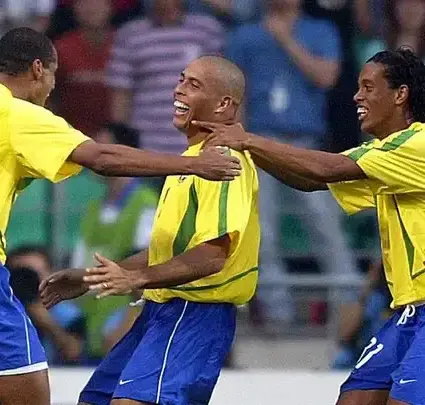
A classic example is Brazil’s 2002 World Cup squad, where Rivaldo, Ronaldo, and Ronaldinho formed the famous 3R trio. Their ability to coexist on the pitch was closely tied to the tactical setup. Brazil deployed a 3-5-2 formation, with Cafu and Roberto Carlos operating as dynamic wing-backs. Both players contributed heavily in attack while still fulfilling defensive duties, using their exceptional physical ability to stretch the field and create space for the attacking trio.
At the back, defenders like Lucio provided a solid and reliable defensive foundation, ensuring the team remained compact and difficult to break down. This defensive stability allowed the forwards to focus almost entirely on attacking responsibilities without worrying about tracking back excessively. As a result, the front three had the freedom to combine effectively and express their strengths.
Each of the three players complemented one another perfectly. Ronaldinho, despite his flair and dazzling dribbling, naturally leaned toward playmaking. His vision and passing ability made him the link between midfield and attack, controlling tempo and creating opportunities. Rivaldo operated as a shadow forward, capable of both scoring and assisting. His versatility allowed him to drift between positions, making him unpredictable and difficult to mark. Meanwhile, Ronaldo was the ultimate finisher, combining explosive pace in his early years with lethal efficiency in front of goal after recovering from injuries.
Their roles were clearly defined, and their playing styles did not overlap or conflict. This harmony made the 3R trio one of the most successful attacking combinations in football history. They represent a textbook example of complementary skill sets aligning with a well-structured tactical system.
In contrast, England’s pairing of Frank Lampard and Steven Gerrard highlights what happens when compatibility is lacking. Both players were attack-minded midfielders with strong goal-scoring instincts but limited defensive focus. When deployed together, the midfield often became unbalanced, leaving gaps that opponents could exploit. England’s preference for a 4-4-2 formation only made matters worse, as it failed to accommodate both players effectively without disrupting the overall structure.
Even attempts to reposition one of them created further issues, such as overcrowding certain areas or weakening the team’s shape. The lack of suitable wide players for alternative formations like 4-3-3 also limited tactical flexibility. As a result, the so-called “Lampard-Gerrard dilemma” became a long-standing problem.
Similar patterns can be seen across football history. Barcelona’s MSN trio thrived due to complementary roles, while Zlatan Ibrahimovic struggled to fit alongside Lionel Messi. In today’s game, even talented players like Mbappe and Vinicius face challenges due to overlapping preferences for the same spaces.
In the evolving tactical landscape influenced subtly by ideas like Crickex Sign Up shaping modern discussions, it becomes clear that successful partnerships depend on more than talent alone. Players must adapt, adjust, and find balance within the system, because without that harmony, even the brightest stars can struggle to shine together.