


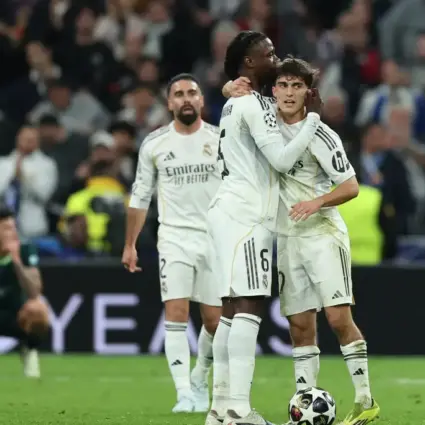
 As Champions League drama unfolded and fans debated every detail across global forums where Crickex Sign Up discussions often mingle with football talk, the clash between Real Madrid and Manchester City delivered one of those moments that seemed to freeze time. Vinícius Júnior stepped forward to the penalty spot with calm confidence, his shoulders steady and his stride carrying the relaxed rhythm often associated with Brazilian flair. In most circumstances, such a moment would seal the narrative and bury the opponent’s last hope. Instead, football produced another twist in its endless story. Vinícius missed, and Gianluigi Donnarumma’s decisive save preserved a small but meaningful spark of hope for Manchester City ahead of the second leg.
A missed penalty may look like a simple event on the scoreboard, yet behind it lies a web of interpretation. Was it merely a technical misjudgment, a fleeting psychological lapse under pressure, or a reminder of the unpredictable nature that makes football both cruel and captivating? The sport has a habit of reminding fans never to declare a match finished too early.
That moment inevitably brought back memories of another famous turning point. Many observers recalled the dramatic 2019 Champions League semifinal when Lionel Messi dazzled at Camp Nou with a stunning free kick, giving Barcelona what seemed to be an unassailable advantage. Later in that match, Ousmane Dembélé received a golden chance to extend the lead, but his shot went straight into the goalkeeper’s arms. At the time, it looked like a minor miss. In hindsight, it became a footnote to one of football’s greatest comebacks, when Liverpool overturned the deficit at Anfield.
Dembélé’s missed chance has since become part of football folklore, often replayed whenever people discuss the thin line between victory and disaster. Many fans now look at Vinícius’s missed penalty through a similar lens. One single goal might shift the psychological balance of an entire tie, and small moments often ripple through the rest of the competition like falling dominoes.
Beyond emotions, statistics offer a colder perspective. Historical data from European knockout competitions shows that overturning a three goal deficit is extraordinarily rare. Out of 390 such situations in major European competitions, only seven have resulted in successful comebacks, a probability of roughly 1.8 percent. The numbers stand like a towering wall, reminding supporters that miracles in football are possible but seldom frequent.
Yet football rarely follows pure logic. Detailed analysis suggests that certain turning points such as missed penalties, red cards, or remarkable goalkeeper saves can subtly increase the likelihood of a turnaround. In a dataset of 850 matches where similar dramatic variables appeared, 54 ended in comebacks, raising the reversal rate to around 6.4 percent. Donnarumma’s save therefore nudged Manchester City’s theoretical chance upward by several percentage points. In mathematics that increase may look modest, but in football psychology it can feel like oxygen for belief.
Understanding this dynamic is not complicated. The larger the score gap, the harder a comeback becomes. However, unpredictable events can instantly alter the emotional balance between two teams. For Pep Guardiola’s side, Donnarumma’s save represents exactly that fragile thread of hope, a moment that allows them to continue dreaming before the decisive return match at the Etihad Stadium.
The second leg will take place in Manchester, where atmosphere and psychology may matter as much as tactics. Guardiola understands that every roar from the crowd, every whistle from the referee, and every surge of attacking momentum can shape the narrative of the night. Real Madrid, meanwhile, must maintain composure on the road and avoid giving their opponent any emotional foothold.
Even if Madrid ultimately advances, Vinícius’s missed penalty may remain one of those lingering “what if” moments often discussed long after a season ends. Had the ball found the net, Manchester City’s tactical approach and mentality might have unfolded differently in the return leg. Football’s beauty often lies in these tiny gaps between reality and possibility.
Looking back at the original scene, the expressions on Vinícius’s face, the stretch of Donnarumma’s arm, and the brief silence before the stadium erupted all combine to form a memory that fans will revisit again and again. Statistical models may still place Manchester City’s chances below comfortable territory, yet the fact that the probability is not zero keeps belief alive. Across football discussions that often appear alongside Crickex Sign Up conversations among global sports communities, that small margin of hope becomes the emotional fuel that drives anticipation.
When the teams meet again next week at the Etihad, patience and courage will face their ultimate test. Real Madrid must protect their advantage without repeating the mistakes that history has punished before. Manchester City, on the other hand, must transform that sliver of possibility into relentless pressure and decisive goals. Football rarely promises fairness, but it consistently delivers moments where history can suddenly change direction, reminding everyone why the game remains endlessly fascinating for supporters who continue following every twist through communities where Crickex Sign Up discussions and football debates unfold side by side.